
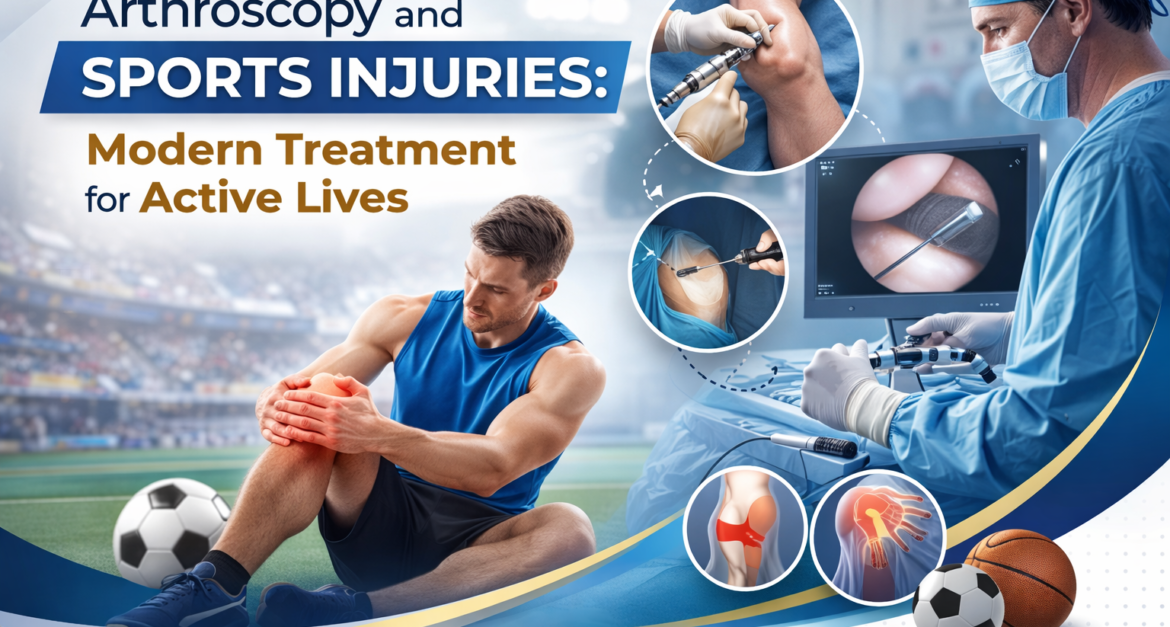
Over the past decade, there has been a noticeable shift toward more active lifestyles. Whether it is recreational sports, gym training, marathon running, football leagues, or simply regular fitness routines, people of all age groups are prioritizing movement. While this has clear physical and mental health benefits, it has also led to a rise in sports-related injuries. Knee, shoulder, and ankle injuries are among the most common reasons individuals consult an orthopaedic specialist today.
Not all sports injuries are severe, and many improve with rest. However, certain injuries, particularly those involving ligaments, cartilage, and joint stability, require timely diagnosis and expert management. Ignoring persistent symptoms can lead to chronic instability, recurrent swelling, and long-term joint degeneration. Understanding the nature of sports injuries — and the role of arthroscopy — helps patients make informed decisions about their care.
Understanding Sports Injuries
Sports injuries can broadly be classified into two categories: acute injuries and overuse injuries. Acute injuries occur suddenly, often due to a twisting motion, fall, collision, or awkward landing. These include ligament tears, meniscal tears, shoulder dislocations, and fractures. Overuse injuries, on the other hand, develop gradually due to repetitive stress placed on tendons, muscles, or cartilage.
Among all joints, the knee is particularly vulnerable. It supports body weight while allowing rotation and flexion — movements frequently performed during sports like football, basketball, tennis, or cricket. A sudden change in direction or improper landing can strain or tear important stabilizing structures such as the Anterior Cruciate Ligament (ACL) or the meniscus.
Common symptoms that should not be ignored include persistent swelling, instability or the sensation that the joint may “give way,” locking or catching while moving, difficulty bearing weight, and pain that returns every time physical activity is resumed. These symptoms often indicate structural damage within the joint rather than a simple muscular strain.
Accurate diagnosis requires a careful clinical examination and, in many cases, imaging such as MRI. Early identification of the exact injury plays a crucial role in determining whether conservative treatment or surgical intervention is necessary.
What Is Arthroscopy?
Arthroscopy is a minimally invasive surgical technique that allows direct visualization of the interior of a joint using a small camera inserted through tiny incisions. Specialized instruments are introduced through additional small portals to repair or reconstruct damaged tissues. This technique has significantly transformed orthopaedic surgery by minimizing soft tissue trauma and reducing recovery time.
The advantages of arthroscopy include smaller incisions, less bleeding, reduced post-operative pain, shorter hospital stay, and faster rehabilitation compared to traditional open surgery. For active individuals, these benefits are particularly valuable because they allow earlier return to daily activities and, eventually, sports.
Arthroscopy is commonly used for treating ligament injuries, meniscal tears, cartilage damage, shoulder instability, and certain ankle conditions. The precision offered by modern arthroscopic techniques helps restore joint stability while preserving as much natural tissue as possible.
ACL Injuries and Reconstruction
One of the most recognized sports injuries is an ACL tear. Patients often describe a popping sensation at the time of injury, followed by immediate swelling and difficulty walking. The ACL plays a vital role in stabilizing the knee during pivoting or twisting movements. Without adequate treatment, repeated episodes of instability can damage cartilage and meniscal tissue over time.
ACL reconstruction is typically performed arthroscopically. The torn ligament is replaced using a graft, which may be sourced from the patient’s own tissue. The goal is to restore stability and prevent future degeneration. However, surgery is only one component of treatment. A structured and progressive rehabilitation program is essential to rebuild strength, coordination, and balance.
Return to sports is gradual and depends on muscle recovery, joint control, and patient adherence to physiotherapy protocols. A carefully guided recovery plan significantly reduces the risk of re-injury.
Meniscal and Cartilage Injuries
The meniscus acts as a shock absorber inside the knee, distributing weight evenly across the joint surface. A tear may cause pain, swelling, and mechanical symptoms such as locking or clicking. Depending on the pattern and location of the tear, the surgeon may repair the tissue or remove only the damaged portion while preserving healthy structure.
Cartilage injuries deserve equal attention. Because cartilage does not regenerate easily, untreated damage can accelerate degenerative arthritis. Arthroscopic procedures aim to stabilize or stimulate healing of cartilage surfaces, thereby protecting long-term joint health.
Shoulder and Ankle Arthroscopy
Sports injuries are not limited to the knee. The shoulder joint, being highly mobile, is susceptible to instability and rotator cuff tears. Recurrent shoulder dislocations can damage surrounding structures and compromise strength. Arthroscopy allows precise repair of torn tissues while minimizing muscle disruption.
Similarly, chronic ankle instability following repeated sprains can affect balance and performance. Arthroscopic stabilisation procedures help restore joint mechanics and prevent further injury.
The Importance of Rehabilitation
Regardless of the procedure performed, rehabilitation remains the cornerstone of recovery. Physiotherapy focuses on restoring range of motion, improving muscle strength, enhancing balance, and gradually reintroducing sport-specific movements. Skipping or rushing this phase increases the risk of complications and re-injury.
Recovery timelines vary depending on the severity of injury and the individual’s health. Minor arthroscopic procedures may allow return to light activities within weeks, whereas ligament reconstruction requires several months of guided rehabilitation.
Do All Sports Injuries Require Surgery?
Many sports injuries can be managed non-surgically. Mild ligament sprains, minor muscle tears, and overuse injuries often respond well to rest, ice, compression, elevation, and targeted physiotherapy. The decision for surgery depends on the extent of structural damage, level of instability, activity demands, and patient expectations.
Professional athletes or individuals involved in high-demand physical activity may require surgical stabilization to restore optimal performance. In contrast, less active individuals may choose conservative management if functional goals can be met without surgery.
Long-Term Joint Protection
Preventing sports injuries involves more than simply being careful during play. Proper warm-up, muscle strengthening, flexibility training, and balanced conditioning programs significantly reduce injury risk. Attention to technique, use of appropriate footwear or protective gear, and avoiding overtraining are equally important.
Prompt medical evaluation of injuries prevents long-term complications. Continuing sports activities despite persistent symptoms may convert a treatable injury into a chronic problem requiring more extensive intervention.
Conclusion
Sports injuries can be disruptive, both physically and psychologically, especially for individuals who identify closely with their active lifestyles. Modern orthopaedics, particularly arthroscopy, has provided precise and minimally invasive solutions for restoring joint stability and function. The primary objective is not merely to repair damaged tissues, but to help individuals return to activity safely and confidently.
Timely diagnosis, appropriate treatment selection, and disciplined rehabilitation together determine long-term success. With advances in surgical techniques and structured recovery protocols, many patients are able to resume their activities with restored strength and stability.
If persistent joint pain, swelling, or instability follows a sports injury, early consultation with an orthopaedic specialist allows accurate assessment and individualized care. Protecting joint health today ensures sustained mobility in the years ahead.