
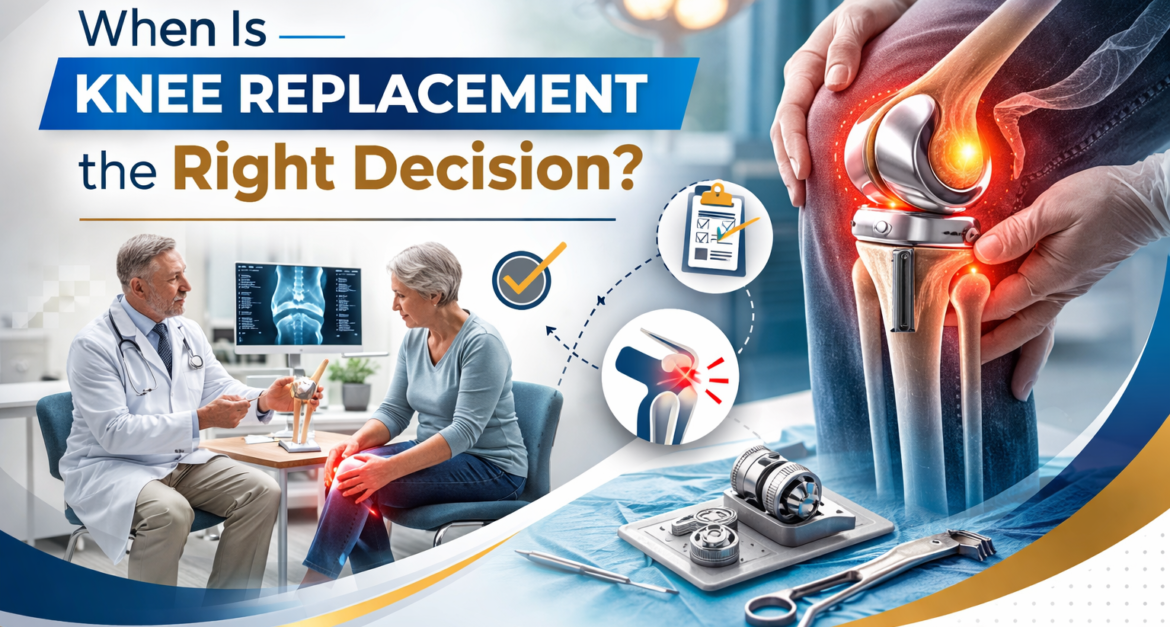
Knee pain rarely begins dramatically. For most people, it enters life quietly — as mild stiffness while climbing stairs, a dull ache after a long walk, or slight discomfort when getting up from a chair. Over time, however, that occasional discomfort may turn into persistent pain that begins to interfere with everyday life. Walking becomes slower. Social outings feel exhausting. Sleep may be disturbed due to constant throbbing in the joint. For many individuals, especially in the later decades of life, this gradual decline is often due to osteoarthritis — a condition in which the protective cartilage within the knee joint slowly wears away.
The knee is one of the largest and most hardworking joints in the body. It functions as a hinge that allows bending and straightening while bearing the weight of the entire body. Healthy cartilage acts as a cushion, enabling smooth, pain-free movement. When this cartilage begins to deteriorate, the bones gradually lose their protective covering and may start rubbing against one another. This friction leads to pain, swelling, stiffness, and, in advanced cases, deformity of the joint. What begins as discomfort during activity may eventually progress to pain even at rest.
A common and very understandable question patients ask is whether knee replacement surgery is inevitable once arthritis is diagnosed. The answer is reassuring: surgery is never the first option. In the early and moderate stages of arthritis, conservative management often provides meaningful relief. Medications to reduce inflammation, structured physiotherapy to strengthen surrounding muscles, weight optimization, activity modification, supportive braces, and intra-articular injections can all play an important role in controlling symptoms. Many individuals are able to maintain function for years with such measures.
However, there comes a stage when conservative treatments no longer provide adequate relief. Pain may become constant and begin affecting quality of life. Tasks that were once routine — walking to the market, climbing stairs, attending family gatherings — become physically taxing. Night pain may interfere with sleep, causing fatigue and reduced overall well-being. In some cases, visible deformity of the knee or progressive bowing of the legs may develop. When pain persists daily, limits independence, and significantly reduces mobility despite appropriate non-surgical treatment, knee replacement becomes a reasonable consideration.
The decision to proceed with knee replacement is not based on age alone, nor is it determined solely by X-ray findings. Imaging does play an important role by showing the extent of cartilage loss and joint space narrowing. However, equally important is the individual’s experience of pain and functional limitation. Two people with similar X-ray findings may have very different symptom severity. Ultimately, the goal of treatment is to restore function and comfort — not merely to correct radiological changes.
Understandably, the idea of joint replacement surgery can cause anxiety. Patients often worry about surgical pain, recovery time, and long-term safety. Fortunately, advancements in orthopaedic care over the last two decades have significantly improved outcomes. Modern anesthesia techniques, refined surgical methods, and structured pain management protocols have made the procedure safer and recovery more predictable. Most patients begin assisted walking within a day or two following surgery, under guided supervision. Early movement reduces complications and helps restore confidence in mobility.
In simple terms, knee replacement surgery involves removing the damaged surfaces of the joint and replacing them with specially designed metal and medical-grade components that recreate smooth joint motion. Contrary to common misconceptions, the entire knee is not removed; only the worn-out surfaces are replaced. The aim is to eliminate bone-on-bone friction, correct alignment, and restore stable movement. The procedure is carefully planned, and implant selection is tailored to the patient’s anatomy and activity level.
Recovery after knee replacement is gradual and requires commitment. Physiotherapy is a vital component of the process, focusing on regaining range of motion, strengthening muscles, and improving balance. While mild discomfort can be expected in the early postoperative period, pain is systematically controlled through multimodal management strategies. Many patients are able to resume light household activities within a few weeks, with continued improvement over three to six months. The sense of relief from chronic arthritic pain often becomes noticeable relatively early in the recovery timeline.
One of the most common concerns is how long a knee replacement will last. Modern implants are designed with durability in mind and frequently function effectively for 15 to 20 years or longer. Longevity depends on several factors, including body weight, activity level, bone quality, and adherence to medical advice. High-impact activities are typically discouraged to preserve the integrity of the implant, but most daily activities — including walking, traveling, and low-impact exercise — can be comfortably resumed.
Another important consideration is timing. Delaying surgery excessively in the presence of severe arthritis can sometimes lead to worsening deformity, muscle weakness, and reduced overall conditioning, which may make rehabilitation more demanding. On the other hand, undergoing surgery prematurely, when symptoms are still manageable conservatively, may not be necessary. The right timing is individual and should be determined after careful discussion between patient and specialist, weighing symptom severity, functional limitation, and expectations.
Knee replacement is ultimately not about replacing a joint alone; it is about restoring independence. Chronic knee pain can gradually limit social engagement, reduce confidence, and diminish overall quality of life. When mobility is compromised, the effects extend beyond the joint itself. Modern orthopaedic intervention offers an opportunity to regain comfort and return to meaningful activities.
Seeking timely evaluation allows for clear understanding of the stage of arthritis and available treatment options. Whether managed conservatively or surgically, the priority remains the same: to relieve pain, restore movement, and improve long-term quality of life. For individuals whose daily lives are constrained by persistent knee pain, exploring the option of knee replacement may represent not an end, but a new beginning toward active and independent living.